From Google Sheet to a real web application
You might remember my previous posts about this project: first a simple Google Sheet with 93 methods, then a GitHub repository with over 100 entries.
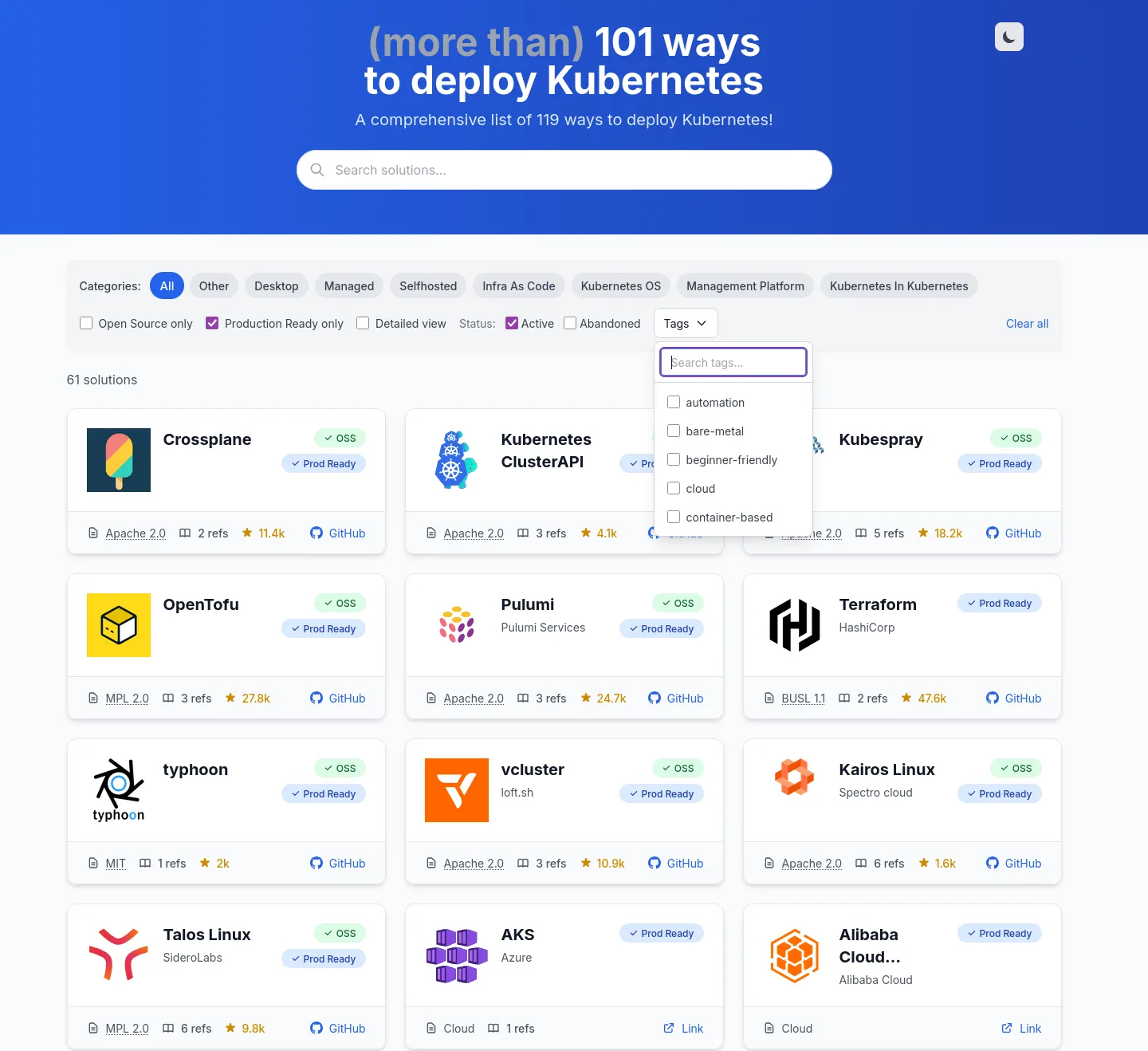
Today, I can present the latest iteration of this project: a real web interface to explore all these solutions!
👉 101-ways-to-deploy-kubernetes
Why a UI?
The Markdown table on GitHub was already better than the Google Sheet for collaboration, but barely. Hard to parse, hard to add columns without it becoming a mess (it already was, haha), and above all, incredibly UGLY.
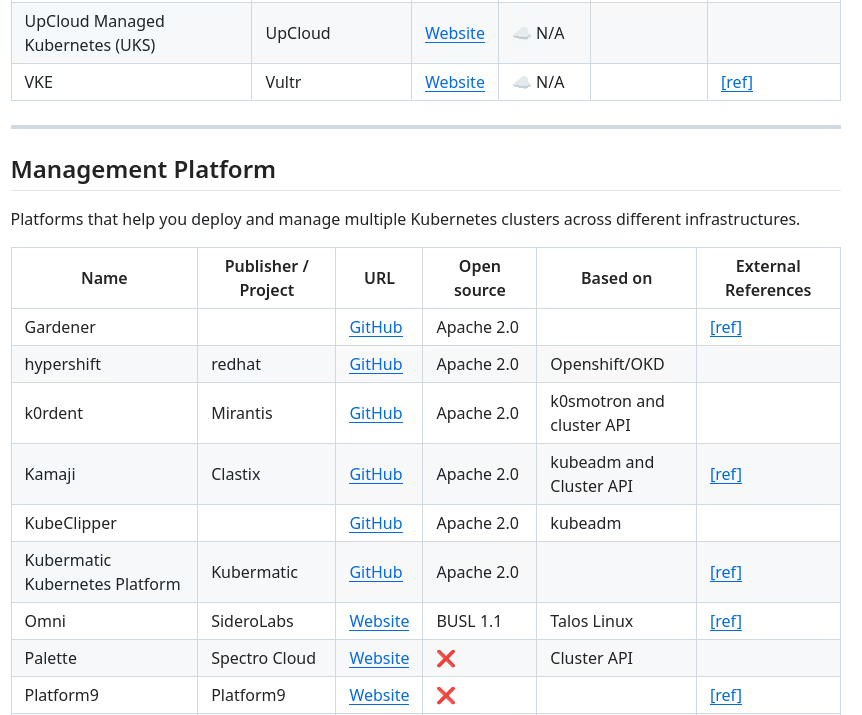
I therefore decided to turn all of this into a modern and intuitive interface, with the help of an LLM.
Tech stack: Astro + Tailwind
For this project, I chose a simple but effective stack:
- Astro: a modern framework that generates ultra-fast static sites
- Tailwind CSS: for hassle-free responsive design
The result? A lightweight, fairly fast site that works on both desktop and mobile (though the desktop experience remains more comfortable given the amount of data).
Features
Cards for each solution
No more spreadsheet-style table worthy of a backend dev (no, worse, a kube engineer…)! Each tool now has its own animated “card” with:
- The project logo
- The license type (OSS or proprietary)
- The GitHub star count
- Direct links to the project and third-party resources (independent blogs, experience reports, tutorials…)

Powerful filters
Looking only for open source solutions? Tools for local development? Management platforms?
Category filters make navigation easy:
- Desktop (local development)
- Managed (cloud offerings)
- Self-hosted (on-premise automation)
- Infra As Code
- Kubernetes OS (specialized operating systems)
- Management Platform
- Kubernetes in Kubernetes
You can also filter by status (active, abandoned) or show only open source or production ready solutions.
A search bar
Know what you’re looking for? Just type the name in the search bar to find the solution instantly.
Tags for refinement
Beyond categories, tags help quickly identify underlying technologies (kubeadm, k3s, k0s…).
Did you know? At least 18 tools use kubeadm!
While compiling all this data, I discovered something fascinating: at least 18 tools use kubeadm as a backend to deploy Kubernetes! 🤯
And that’s not even counting the managed Kubernetes offerings from cloud providers!
This is exactly the kind of information you can now visualize instantly thanks to this new interface.
A collaborative project
The project remains 100% open source and collaborative. The data is still stored in the GitHub repository, and the UI is automatically generated from that data (I even added PR previews).
Is a tool or provider missing? Spotted a bug? Feel free to open an issue or submit a Pull Request!
The project now lists 118 solutions (and I know there are certainly more missing), each with:
- Up-to-date links
- Project status
- External references (tutorials, experience reports…)
Try it, comment, share
Head over to zwindler.github.io/101-ways-to-deploy-kubernetes to explore all these solutions!
OK, this is a shameless “call to action” like you see on every social network. Fair enough.
However, I can’t know if this is useful (or not) if you don’t tell me. I can leave it as is (it’s not a big deal, I have plenty of other projects waiting for my spare time) or keep it alive, if you like it / find it useful.
And if you do find this project useful, please:
- Star the project on GitHub
- Share it with your colleagues in the Cloud Native community
- Contribute by adding missing tools or fixing errors
Thanks in advance! 🙏